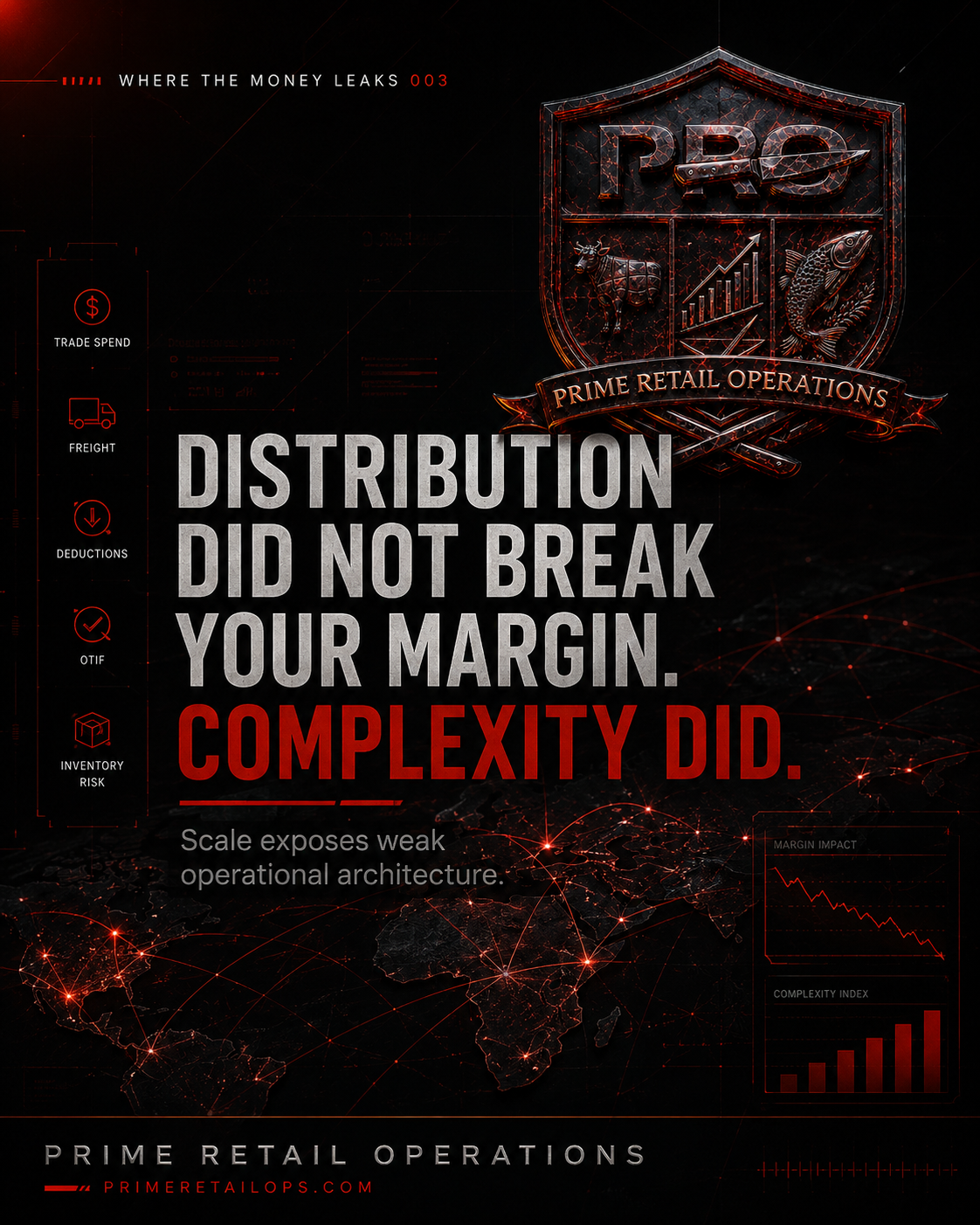
Distribution did not break your margin.
Complexity did.
That distinction matters.
Broadline and specialty distributors are infrastructure. They move product through a fragmented retail system most emerging brands could never reach efficiently on their own. They consolidate orders, move inventory, manage DC networks, and create access to retailers that would otherwise be difficult or impossible to serve at scale.
The distributor is not usually the villain.
The problem starts when a brand treats distribution expansion like a sales victory instead of an operational stress test.
A brand with three SKUs, one region, one distributor DC, and a narrow promotional calendar can usually manage the business with a lean team and a few well-built spreadsheets.
Then growth starts.
More SKUs.
More DCs.
More retailers.
More brokers.
More promotions.
More freight lanes.
More inventory positions.
More deduction codes.
More ways for the model to leak.
Nothing breaks all at once. The business just becomes harder to control.
That is where margin pressure shows up.
Not because distribution is inherently bad, but because distribution exposes the parts of the operating model that were never built to handle complexity.
The first illusion is gross margin.
Many brands model profitability at the manufacturing level. They know their COGS. They know their list price. They know the margin they think they have before the product enters the distributor network.
But gross margin is not the number that keeps the business alive.
True net landed margin is what matters after freight, trade spend, deductions, spoilage, admin fees, fill-rate penalties, promotional chargebacks, and working-capital drag are accounted for.
That is the number most brands do not understand early enough.
The second illusion is placement.
Placement is not demand.
Getting product into a DC is not the same as getting product through the register. A distributor PO may represent pipeline fill, warehouse stocking, or promotional load-in. It does not automatically prove consumer pull-through.
If downstream velocity does not follow, that inventory becomes a liability.
In refrigerated and frozen categories, that liability gets expensive quickly.
Cold chain does not forgive weak forecasting. Every additional DC creates another inventory position that must be funded, monitored, rotated, and depleted before code life becomes a problem. Every small LTL shipment carries freight exposure. Every delay tightens the freshness window. Every overbuilt pipeline increases the odds of spoilage, unsalables, and deduction pressure.
That is why complexity scales faster than revenue.
Adding one SKU does not just add one more item.
If that SKU enters five DCs, ten retailers, two promotional calendars, and multiple freight lanes, it creates an operating matrix that someone has to forecast, fund, monitor, and reconcile.
Sales may see expansion.
Operations sees nodes.
Finance sees deductions.
The founder sees cash getting tighter even though revenue is growing.
That is the trap.
Distribution creates possibility. It does not create control.
Control has to be built inside the brand.
Strong operators manage distribution differently.
They do not confuse pipeline fill with velocity.
They do not assume the broker owns operational discipline.
They do not approve promotions without understanding the full cost stack.
They do not expand DCs before they can support localized pull-through.
They do not write off deductions as background noise.
They do not let SKU count grow faster than forecast accuracy.
They treat distribution as a mathematical discipline.
The best brands are not anti-distributor. They are distribution-literate.
They understand that distributors protect their own operating model. That is not personal. That is business. If a supplier ships late, shorts orders, misses ASNs, overbuilds inventory, funds unprofitable promotions, or sends product into regions without velocity, the system will punish that lack of control.
The answer is not to blame the system.
The answer is to build a brand that can operate inside it.
That requires true net landed margin by SKU, DC, retailer, promotion, and freight lane. It requires weekly S&OP discipline. It requires deduction tracking. It requires SKU discipline. It requires knowing when to say no to expansion that looks good on paper but destroys margin in practice.
The uncomfortable truth is simple:
Distribution did not break your margin.
It revealed that the operating architecture was not ready for the complexity.
Operator Takeaway
Distribution does not create operational discipline.
It exposes whether discipline already exists.
Placement creates possibility.
Operational control determines whether the brand survives the expansion.